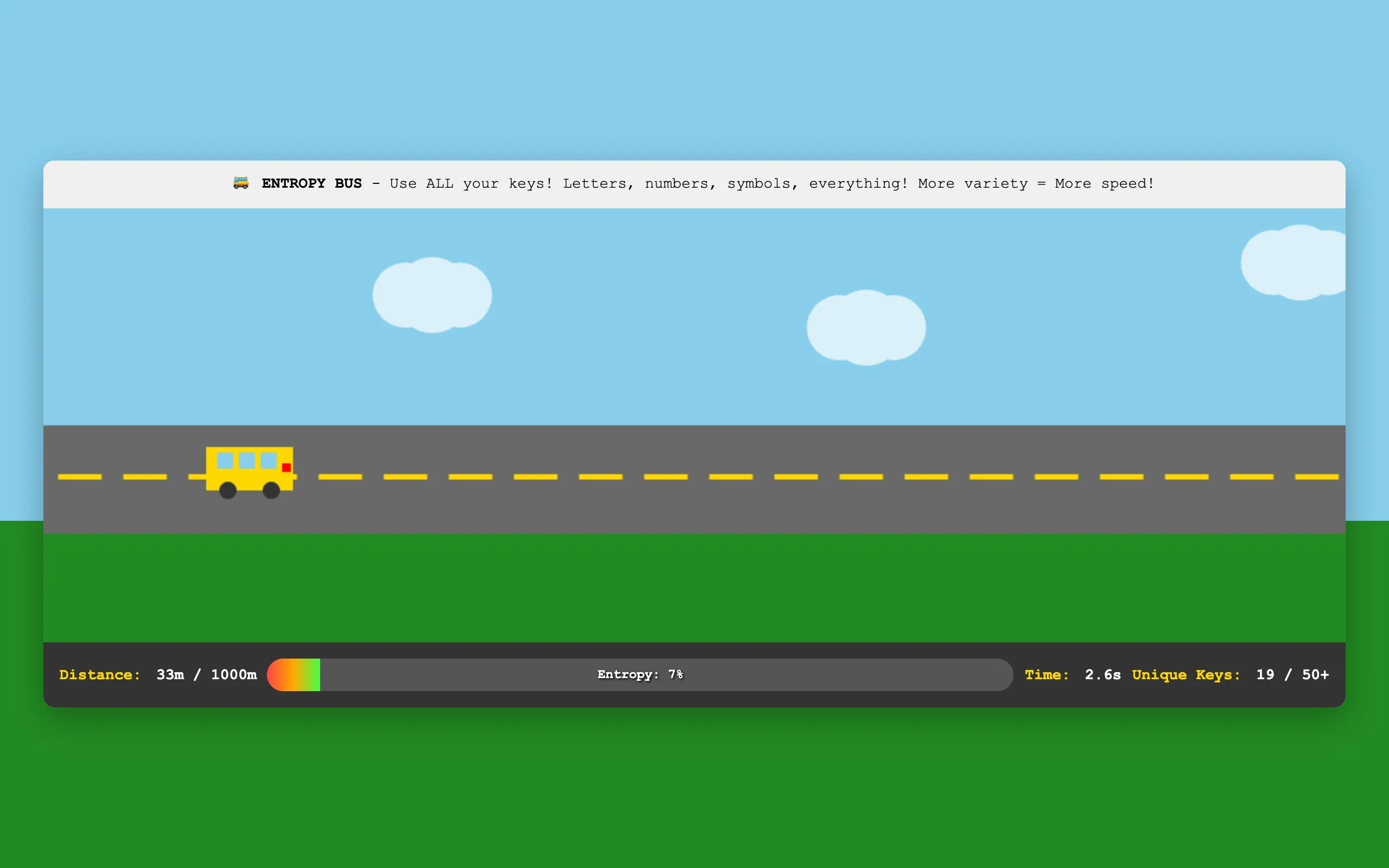
The bus accelerates on the Shannon entropy of whatever you type. Hold one key and it crawls. Use everything on the keyboard, letters, digits, punctuation, shifted symbols, with no rhythm to it, and it moves.
Scoring a keypress
I keep the last four seconds of keypresses. Fewer than five distinct keys in that window scores 0.05 and fewer than ten scores 0.15. Past that I take the entropy of the key frequencies,
\[H = -\sum_{i} p_i \log_2 p_i\]and divide by \(\log_2 n\) for the \(n\) distinct keys seen, which puts it between 0 and 1.
That number on its own was too easy to max out. Five keys pressed in equal proportion score a perfect 1, and five keys isn't much randomness. So I multiply by a diversity term, \((n/50)^{2.5}\), which is why the unique-key counter in the corner runs to 50. Then pattern checks over the last 15 presses knock the score down. More than two adjacent-character steps like "asdf" halves it. More than three ABAB alternations multiplies it by 0.6. Any two-key sequence repeated more than twice multiplies it by 0.7. A final factor rewards typing quickly, up to about 10 presses a second. I don't look at rhythm on desktop at all, only on mobile.
Each keypress adds 0.8 times that score to the bus's velocity, capped at 15, and velocity loses 4 percent every frame. Stop typing and the bus coasts to a stop within a second or two. The race is 1000 meters.
Playing it
Fingers get tired, but what actually slows the bus is that my brain wants to settle into a sequence and repeat it, and the score drops the moment it does. I found myself doing strange things while playing, like closing my eyes and typing with my palms. Humans are bad at generating random sequences on demand. We avoid repeating a key and overuse alternation.
On a phone there's one big button instead, so key variety is gone. There I score the standard deviation of the intervals between taps, divided by 200 ms and capped at 1, times a rate factor. Tapping at irregular intervals beats tapping to a beat.
My best runs come in around 80 seconds. Getting under 70 means keeping the bar green the whole way.