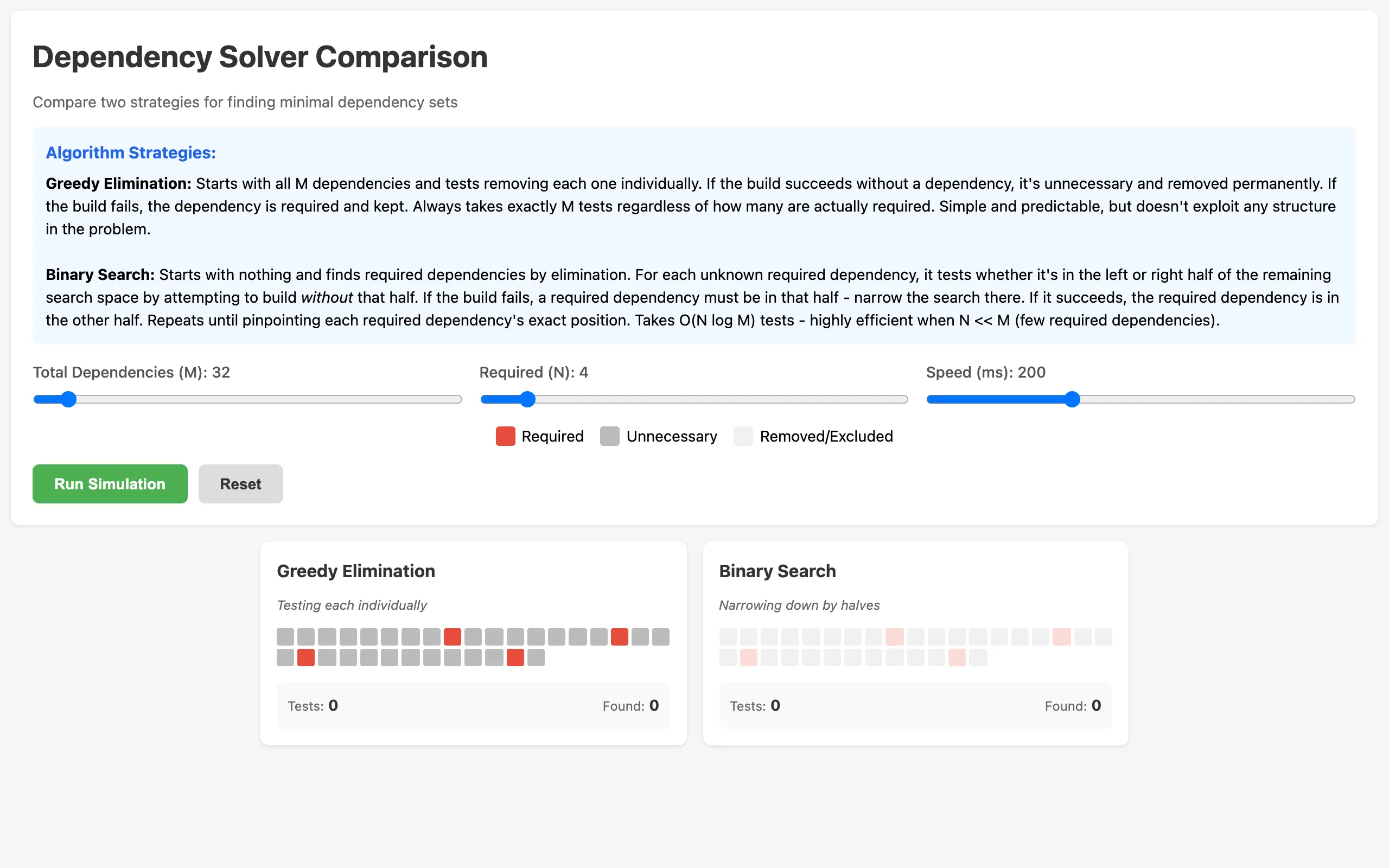
A project declares 100 dependencies and needs a handful. The rest are left over from deleted features or already pulled in by something else. The only test available is whether the build passes with a given subset, and each test takes time. I wanted to see how the two obvious strategies compare, so I made a page that runs both side by side on the same grid of squares.
I model \(M\) declared dependencies of which \(N\) are required, and a build oracle that passes exactly when every required one is in the set. That makes the oracle monotone: if a set builds, so does any superset. Version constraints don't exist here.
Greedy elimination
Start with everything included. Remove one dependency and test. If the build passes, leave it out for good. If it fails, put it back. Move to the next. This takes exactly \(M\) tests no matter what \(N\) is. You know how long it'll take before it starts.
Binary search
The second strategy finds the required dependencies one at a time, leftmost first, each with a binary search. Keep a set of the ones found so far. For a range of positions, test the build with everything included except the left half of the range (the found ones always stay in). If it passes, nothing in that half is required and the search moves to the right half. If it fails, something in the left half is required and the search narrows to it. When the range is down to one position, that's a required dependency. Add it to the found set and start over from the leftmost position not yet found.
Each round is a binary search over at most \(M\) positions, so about \(\log_2 M\) tests, and there are \(N\) rounds. Roughly \(N \log_2 M\) tests in total. The information-theoretic floor is \(\log_2 \binom{M}{N}\), which is \(\Theta(N \log(M/N))\), so this is close to the best possible when \(N\) is small. At the default settings, 32 dependencies with 4 required, greedy takes 32 tests and binary search about 20. At 256 with 4 required, greedy takes 256 and binary search about 32.
When \(N\) approaches \(M\) it goes the other way. Every round still pays a logarithmic search to find the next required dependency, even though nearly all of them are, so the total climbs past \(M\) and greedy wins. With \(N = M\) on the sliders, binary search loses.
Watching it
Both grids show the same layout. Squares being tested glow, required ones turn red, and eliminated ones turn gray. A counter under each grid shows tests so far and required dependencies found. The speed slider goes from 50 to 500 ms per test, slow enough to follow each decision or fast enough to run a dozen configurations in a minute and get a feel for where the crossover is. When both finish, I highlight the one with fewer tests.