Body length (C. elegans)1 thousandths m
2.8 thousandthsHip widths
200 millionthsBalance beam lengths
About 1 mm
The world's least useful encyclopedia
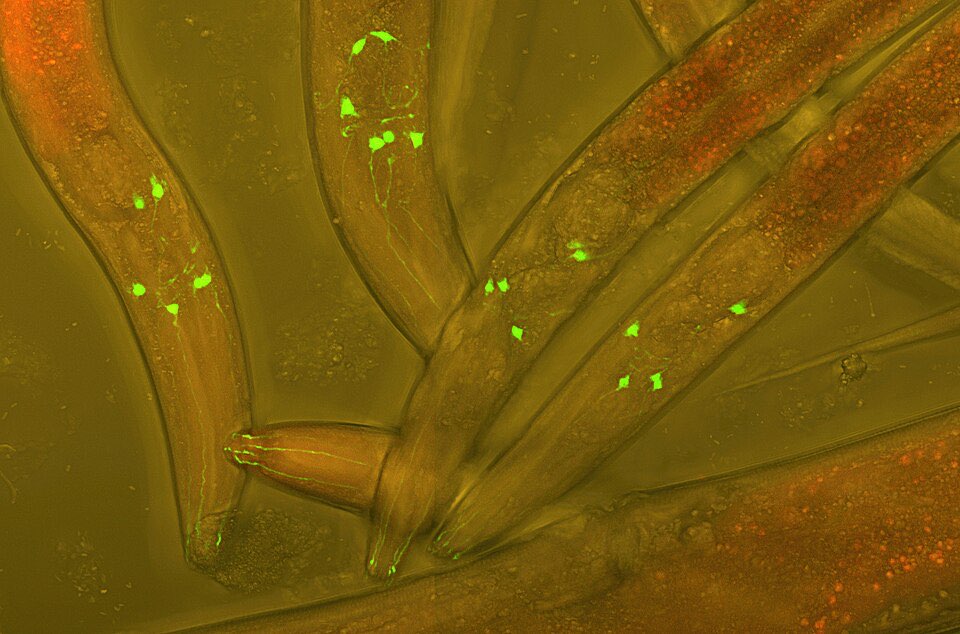
Photo from Wikimedia Commons
The most abundant animal on Earth, with 57 billion per human/Microscopic Life
Nematodes, or roundworms, are the most abundant multicellular animals on Earth. An estimated 57 billion nematodes exist for every human being. A single handful of soil may contain several thousand individuals. Most are microscopic, between 0.1 and 2.5 mm long, though some parasitic species can reach over a meter. The model organism Caenorhabditis elegans has exactly 959 cells in the adult hermaphrodite, making it one of the best-studied animals in biology. It was the first multicellular organism to have its complete genome sequenced and its entire neural connectome mapped (302 neurons, roughly 7,000 synapses).
About 1 mm
About 1 microgram
About 20 days