Overall length13.2 m
14.5Umbrellas
27.5Office chair heights
85.7 billionCarbon atoms
About the size of a large school bus
The world's least useful encyclopedia
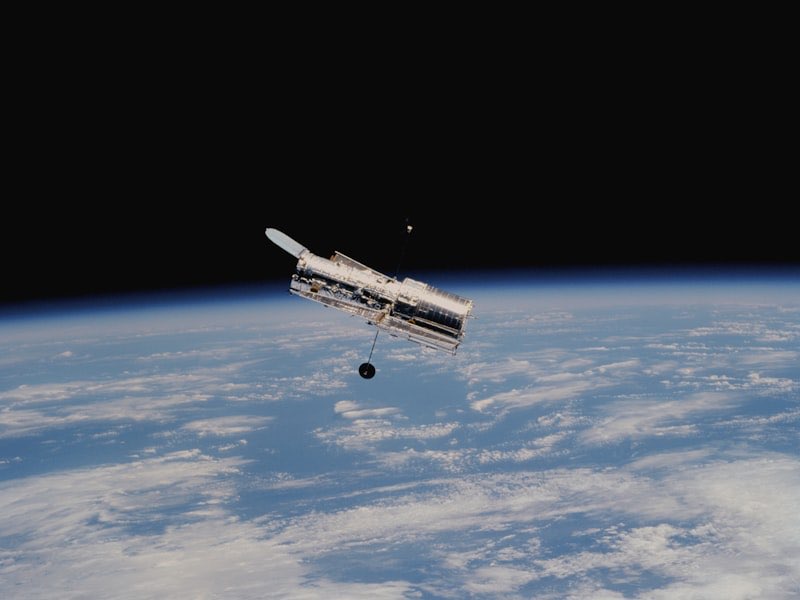
Photo by NASA on Unsplash
Humanity's eye on the cosmos since 1990/Spacecraft
Launched aboard Space Shuttle Discovery in April 1990, the Hubble Space Telescope orbits Earth every 95 minutes at roughly 540 km altitude. It has produced some of the most iconic images in astronomy, from the Pillars of Creation to the Hubble Deep Field. Despite an embarrassing mirror flaw at launch (fixed by a literal pair of corrective glasses in space), Hubble has been one of the most productive scientific instruments ever built.
About the size of a large school bus
~24,500 lbs; serviced five times in orbit
Polished to within 10 nanometers of a perfect curve
~27,000 km/h in low Earth orbit
Two 25-foot solar panels; about enough to run a hair dryer
~540 km above Earth's surface
At the widest point of the spacecraft body
~95 minutes per orbit; about 15 orbits per day