Age of the universe435 quadrillion s
906 trillionShowers
2 billionDog years
5 trillionMayfly lifespans
About 13.8 billion years
The world's least useful encyclopedia
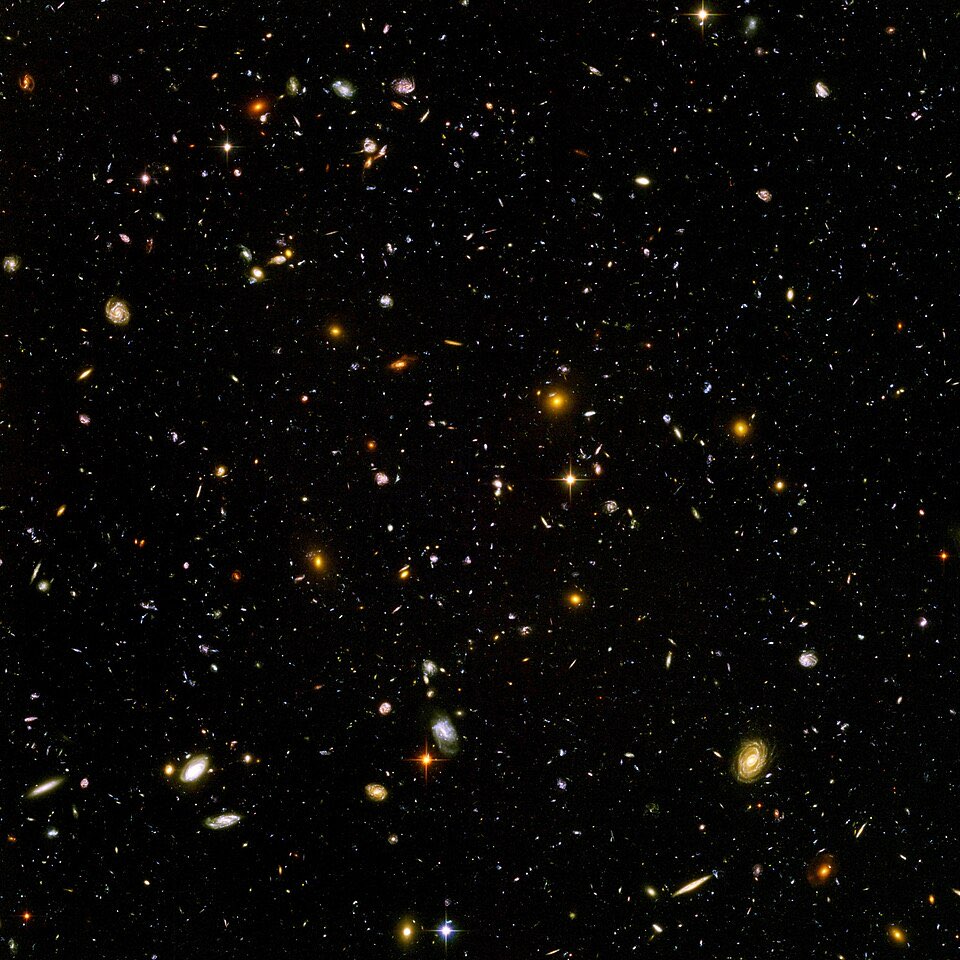
Photo from Wikimedia Commons
13.8 billion years since the Big Bang, measured to within 1% accuracy/Collective & Conceptual
The age of the universe is estimated at 13.787 billion years (with an uncertainty of about 20 million years), based on measurements of the cosmic microwave background radiation by the Planck satellite, combined with observations of the expansion rate of the universe. This age is determined by working backward from the current expansion rate (the Hubble constant, about 67.4 km/s per megaparsec) and accounting for the changing rate of expansion over time. In the first fraction of a second after the Big Bang, the observable universe expanded from a point smaller than an atom to larger than a grapefruit. Today, the observable universe has a diameter of about 93 billion light-years because the expansion of space has carried the most distant objects far beyond where their light was originally emitted.
About 13.8 billion years
About 93 billion light-years
67.4 km/s/Mpc
About 20 million years